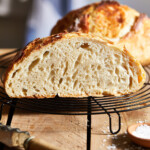
Easy Rustic Bread Recipe
This Easy Rustic Bread Recipe makes a chewy, airy no-knead loaf with four ingredients and a crisp, deeply browned Dutch oven crust.
Servings: 8 slices
Equipment
- Bench Scraper or flexible spatula
Ingredients
- 3 1/2 cups bread flour 455 g; King Arthur Bread Flour used
- 1 packet active dry yeast 7 g or 2 1/4 teaspoons; Red Star used
- 2 teaspoons Morton kosher salt or 4 teaspoons Diamond Crystal kosher salt or 1 teaspoon fine sea salt/table salt
- 1 2/3 cups warm water 395 ml; 110°F
Instructions
- Combine the dry ingredients. Add the bread flour, active dry yeast, and Morton kosher salt to a large mixing bowl. Whisk until evenly distributed. You do not need to activate or proof the yeast separately.3 1/2 cups bread flour
1 packet active dry yeast
2 teaspoons Morton kosher salt - Add the warm water. Pour the 110°F water evenly over the dry ingredients. Without a thermometer, it should feel comfortably warm but not hot.1 2/3 cups warm water
- Mix the dough. Stir from the bottom of the bowl until no dry flour remains, scraping the bottom and sides as needed. The dough should look very wet, sticky, shaggy, and somewhat lumpy; it will not form a kneadable ball. Do not add extra flour.
- Cover the dough. Scrape the dough toward the center of the bowl and cover it tightly with plastic wrap. If helpful, mark its starting height on the outside of the bowl.
- Set up the same-day rise. Place the covered bowl in a draft-free spot at room temperature.
- Let the dough rise. Let it rise for 2–3 hours. In a very warm kitchen, begin checking after 1 hour; otherwise, begin at 2 hours. When it is close to doubled and becoming bubbly, begin preheating the Dutch oven. Continue once the dough has at least doubled, looks bubbly across the top, and jiggles when the bowl moves.
- Preheat the Dutch oven. While the dough finishes rising, place the Dutch oven and lid on the middle rack and preheat the oven to 450°F for at least 30 minutes. Confirm that the pot, lid, handles, and lid knob are safe at this temperature.
- Release the dough. Run a silicone spatula, plastic bench scraper, or flexible spatula around the edge of the bowl, scraping inward to loosen the dough without pressing out its bubbles.
- Transfer the dough. Generously flour a clean work surface, then turn the dough onto it. The dough will be soft and may begin to spread; this is normal.
- Fold the dough gently. Use the scraper to lift one edge toward the center. Repeat around the dough a few times, just until it begins to hold together.
- Shape the loaf. Flip the dough so the folded seam is underneath. Use one hand and the scraper to gently tap and tuck the edges into a rough round without pressing out the bubbles.
- Score the top. Cut an X into the top with a sharp paring knife or bread lame. It does not need to look perfectly even.
- Move the loaf to parchment. Use the scraper to support the soft dough as you move it onto the center of a sheet of parchment paper.
- Lower the loaf directly into the Dutch oven. The same-day loaf does not rise again after shaping. Wearing oven mitts, remove the hot pot and lid. Use the parchment as handles to carefully lower the loaf into the pot.
- Cover the Dutch oven. Replace the preheated lid and return the pot to the middle rack.
- Bake the loaf covered. Bake for 30 minutes without lifting the lid.
- Finish baking uncovered. Wearing oven mitts and keeping your face and hands away from the escaping steam, remove the lid. Bake for another 10–15 minutes, until the crust is deep golden brown and firm. The center should register 200–205°F. Without a thermometer, carefully lift the loaf and tap the bottom; it should sound hollow.
- Cool before slicing. Use the parchment to lift the loaf from the pot and transfer it to a wire rack. Cool for about 1 hour before slicing so the crumb can finish setting.
Notes
- Flour measurement: For the most consistent dough, weigh 455 g bread flour. Without a scale, fluff the flour, spoon it lightly into the measuring cup, and level it with a straight edge. The dough should remain very wet and sticky; use flour on the work surface and a bench scraper or flexible spatula instead of adding flour until it becomes kneadable.
- Yeast and rise: Active dry or instant yeast can be used in the same amount, but instant yeast may rise faster. In a very warm kitchen, begin checking the dough after 1 hour. Continue once it has at least doubled and looks bubbly across the top.
- Salt conversion: The recipe was tested with Morton kosher salt. Substitute 4 teaspoons Diamond Crystal kosher salt or 1 teaspoon fine sea salt or table salt for the 2 teaspoons Morton.
- Make-ahead method: After mixing, cover and refrigerate the dough immediately for about 24 hours, until doubled and bubbly; do not complete the room-temperature rise first. Twelve hours was not sufficient in testing. Shape and score the dough directly from the refrigerator, place it on parchment, and rest it for about 30 minutes while the Dutch oven preheats. Bake at the same temperature and for the same amount of time as directed above.
- Storage: Store the cooled loaf on the counter for 1–2 days, then slice and freeze the remainder for up to 3 months. Separate slices with parchment or freeze them in a single layer until firm. Toast directly from frozen or thaw on the counter for about 10 minutes; do not refrigerate the baked bread because it dries out.
Nutrition
Calories: 208kcal | Carbohydrates: 42g | Protein: 7g | Fat: 1g | Saturated Fat: 0.1g | Polyunsaturated Fat: 0.4g | Monounsaturated Fat: 0.1g | Sodium: 482mg | Fiber: 2g | Sugar: 0.2g